Eco-Friendly Disposable Takeaway Boxes: A Bulk Buyer’s Testing Checklist
2026-10-17
A takeaway box can look right on a purchasing desk and still fail during service. The questions change once staff fill it with food, close it, stack it inside a delivery bag and hand it to a courier. For bulk buyers, the most useful sample review follows that journey—not just the appearance of an empty container.
When sourcing eco-friendly disposable takeaway boxes, verification should connect three things: the intended food application, the evidence supporting the material specification, and the standard expected from production orders.
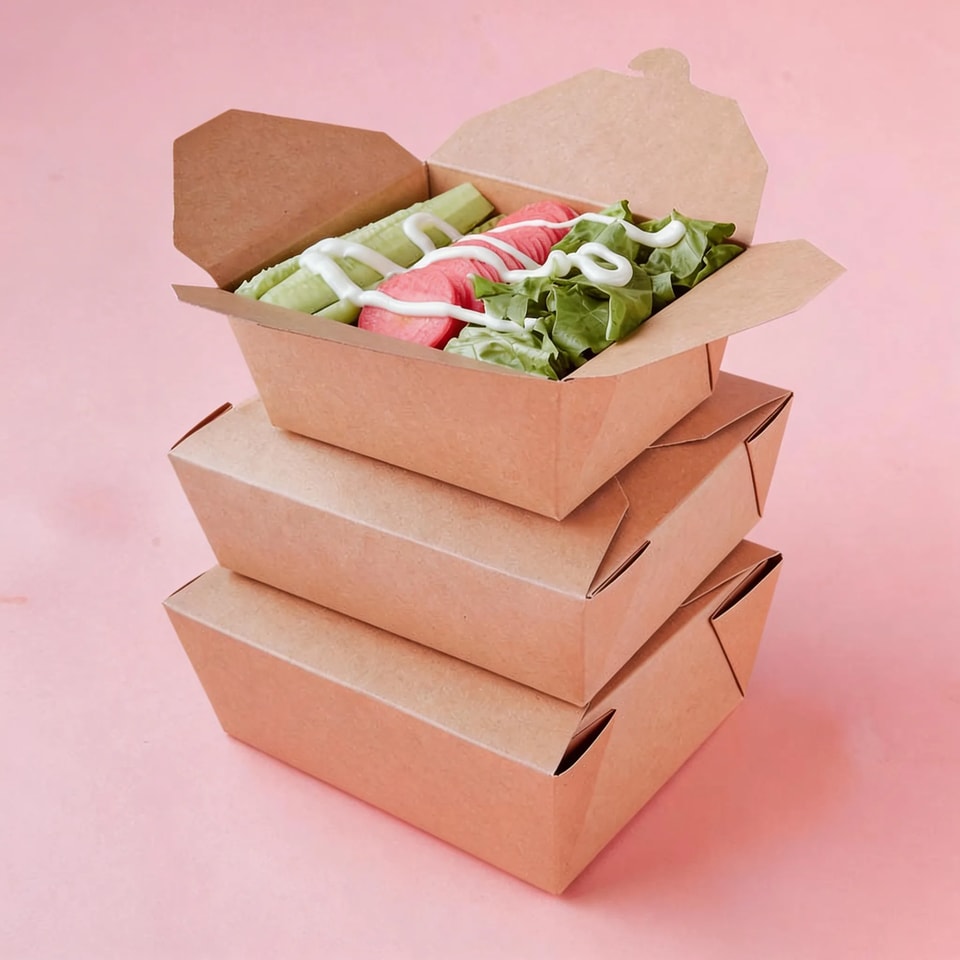
Anbao’s paper food containers include formats presented for fast food, bento meals, fruit salads and takeaway packaging. Those applications provide a starting point for selection, but buyers still need to confirm the exact product configuration and test it against their own service conditions.
The following checklist turns sample evaluation into a documented purchasing decision. Operational trials assess usability; they do not replace food-contact compliance review or laboratory testing.
Define the Service Conditions Before Requesting Samples
Match the Sample to the Food, Not Just the Box Size
Start the sample request with the menu. Describe the food, portion weight, moisture and oil content, serving temperature and any sauces packed inside the container.
A nominal capacity alone leaves important questions unanswered. Ask the supplier to confirm dimensions, practical filling space and the clearance needed for secure closure. Evaluate the portion in the finished box rather than choosing solely from a catalogue image.
For a mixed menu, request samples for representative applications. A dry sandwich and a sauced rice meal should not receive the same approval simply because both fit inside the box. Document which foods each selected SKU is intended to carry.
Document Holding Time, Delivery Handling and Destination Market
Map the route from filling to consumption. Include the wait before dispatch, normal delivery duration, bag arrangement and expected stacking.
Use these conditions to build a repeatable trial. Record actual filling temperatures and observation times instead of adopting an arbitrary test duration.
Identify the destination market early, too. For products placed on the EU market, the European Commission states that food-contact materials must comply with Regulation (EC) No 1935/2004. Ask the supplier what documentation supports the proposed configuration in the country where it will be used.
Verify Materials, Food-Contact Documents and Environmental Claims
Identify the Paperboard, Barrier Layer and Closure Components
Request a material description for the exact SKU: paperboard, any barrier layer, separate lid, and other relevant components. Where paperboard grammage forms part of the specification, record it alongside dimensions and structure.
Anbao’s public product guidance discusses PE, PLA and aqueous coating options. That does not establish that every takeaway-box format is available with every coating; availability must be confirmed for the selected item.
Avoid approving a sample described only as “kraft paper.” Ask what the complete food-contact structure contains and which material version will be supplied in bulk.
Check Whether the Documents Cover the Product You Are Buying
Review documentation against the ordered product, not just the supplier’s company name. Check the manufacturing entity, material identification, intended application, report date and relevant test conditions.
Paper and board can transfer substances into food. The Council of Europe’s EDQM guidance addresses material requirements, functional barriers and testing used to assess food-contact safety. An operational trial that shows no leakage therefore cannot establish chemical compliance.
Ask the supplier to explain how its supporting documents relate to your proposed food types and contact conditions. Refer unresolved questions to your compliance team or a qualified testing laboratory before approval.
Treat Recyclable and Compostable as Separate Claims
Do not use “paper-based,” “recyclable” and “compostable” interchangeably. Anbao’s public guidance also distinguishes these terms rather than treating them as equivalent.
For each proposed environmental statement, request its basis and scope. Does the evidence cover the finished package or only one material? What disposal conditions does the claim require? Does the lid fall within the same assessment?
Until those questions are answered, avoid copying a broad supplier description onto consumer-facing packaging.
Test Samples with Real Food and Repeatable Conditions
Check Dimensions, Forming Quality and Closure Fit
Begin with empty samples. Check dimensions, forming, edges, folds, seams and the relevant closure mechanism. Use the proposed lid or locking arrangement—not a convenient substitute.
Select checks appropriate to the structure. A folding carton needs attention to creases and locking tabs; a formed container with a separate lid needs a fit assessment.
Record defects with photographs and product references. “The lid does not stay closed after filling” is useful feedback. “Quality needs improvement” is not specific enough to guide a revised sample.
Evaluate Leakage, Grease Marks and Shape Retention
Fill samples with representative menu items under recorded conditions. Include foods that present different challenges within the intended application, rather than testing only the easiest item.
At agreed observation points, inspect:
- Liquid escaping through seams, corners or closure areas.
- Grease marks appearing on the exterior.
- Changes in the base or sidewall shape.
- Closure performance after food contact.
- Handling condition when the filled package is lifted.
Describe what happened without diagnosing the cause prematurely. An exterior grease mark and liquid leaking from a seam are different observations and may require different supplier responses.
Anbao lists food-container applications, but the available category information does not establish a universal temperature rating or leak-test result for every product. Treat those limits as questions to resolve, not figures to invent.
Reproduce Stacking, Bagging and Delivery Handling
Next, repeat the actual packing sequence: fill, close, place in the delivery bag, stack as usual and move through representative handling conditions.
Inspect the packages after unloading, including those at different positions in the stack. Record the number and arrangement of containers so the supplier can reproduce the trial.
Avoid presenting an informal bagging exercise as certified transport testing. Its purpose is narrower: to establish whether the proposed packaging arrangement suits your operation. If the trial exposes a problem, revise the product or packing specification and test again before bulk approval.
Check Custom Printing and Kitchen Usability
Approve Artwork on the Actual Packaging Material
Anbao publicly offers logo, pattern, colour and size customisation. When discussing custom foodservice packaging, connect the design brief to a specific box format and material.
Use the correct template, then examine the formed sample. Check logo position, text readability, colours and the effect of folds or seams.
A digital proof can confirm wording and layout, but agree separately how physical print appearance will be approved. Retain the artwork version and approved print reference; do not assume that a monitor image defines the acceptance standard.
Test Opening, Filling, Closing and Storage in Service
Ask kitchen staff to work with the samples. Observe whether they can separate, open, fill, close and bag the containers using the normal service sequence.
Include storage and identification in the review. Staff should be able to distinguish similar sizes and match any separate lids correctly.
Record specific difficulties rather than claiming unmeasured productivity gains. An operational issue should become a design question or specification change before it becomes a recurring complaint across stores.
Turn Sample Approval into Bulk-Order Acceptance Criteria
Retain an Approved Reference Sample and Versioned Specification
Keep an approved physical sample with the corresponding written specification. Identify the SKU, dimensions, material configuration, closure components, artwork revision and packing arrangement.
Use the sample as a reference, not as the entire contract. Agree measurable tolerances where necessary and identify any remaining approvals before releasing production.
Anbao’s published procurement guidance recommends aligning product configuration, artwork, packing and final sample approval before confirming production orders. Apply that discipline to the selected takeaway-box configuration rather than copying specifications from another packaging category.
Agree on Inspection Rules and Defect Categories
Define defects in terms both parties can recognise. Examples include failure to close, leakage under agreed trial conditions, incorrect artwork and wrong carton quantities.
Then agree how production lots will be checked: sampling method, inspection stage, acceptance criteria and the response to nonconforming goods. If an AQL-based plan is selected, specify the plan and defect classifications rather than quoting an unexplained AQL number.
Include a resolution process. State who receives inspection findings, what evidence is required, and whether affected goods need correction, replacement or further review.
Ask How Production Records Support Consistency
Ask how the supplier identifies incoming materials, records production batches and links finished cartons to inspection information. Discuss the checks relevant to printing, cutting, forming, closure construction and packing for the chosen product.
Anbao describes a digital factory and intelligent, flexible production system on its official website. That is a basis for further questions—not proof that every SKU has a particular inspection technology.
Request order-specific information about traceability and quality records. Digital manufacturing matters to procurement when it supports clear specifications, controlled changes and retrievable evidence.
Review Supplier Evidence and Delivery Readiness
Use Certifications and Project Cases Within Their Actual Scope
Anbao’s official materials list BSCI, BRC, ISO and FSC-related credentials. Request current supporting documents and verify the relevant entity, facility, scope and validity. Do not infer ISO 9001, ISO 14001 or GMP certification from a generic reference to “ISO.”
Project evidence also needs boundaries. Anbao’s food packaging application projects describe a 2017 development for BP: a top-and-bottom rolled double-wall coffee cup intended to address handling comfort and remove the need for a separate sleeve.
The useful connection is the development process—starting with a service requirement and modifying the structure. It is a paper-cup case, not evidence of takeaway-box leak resistance, compostability or delivery performance.
Confirm Carton Specifications, Order Timing and Change Control
Approve the shipping configuration alongside the product. Confirm carton counts, labels, external dimensions, pallet requirements where relevant, and receiving arrangements.
Separate sample preparation, artwork approval, production and shipment milestones. Obtain order-specific MOQ and lead-time commitments instead of treating general manufacturing capacity as a delivery guarantee.
Finally, establish change control. Require written agreement before substituting materials or changing dimensions, closure components, artwork or packing. Repeat supply should refer to the approved version, with any change reviewed for its effect on use and documentation.
Make the Purchase Decision with a Documented Checklist
Separate Product Approval from Supplier and Delivery Approval
Use a compact decision record so a successful food trial does not conceal missing documents or unresolved logistics.
| Approval area | Evidence to retain |
| Food and service suitability | Recorded filling, holding and handling trial |
| Materials and compliance | SKU-linked specification and relevant supporting documents |
| Environmental claims | Evidence covering the proposed statement and product |
| Customisation | Approved artwork and physical print reference |
| Bulk-order quality | Agreed inspection rules and reference sample |
| Supply readiness | Confirmed packing, milestones and change-control terms |
Mark each area approved, awaiting clarification or requiring resampling. Release the order only when unresolved points have been addressed by the responsible purchasing, operations or compliance team.
Send a Complete Sample and Quotation Brief
Anbao’s public inquiry guidance requests details including product type, capacity, quantity, design, coating preference and destination. Add your food application, handling conditions and acceptance requirements.
When requesting eco-friendly disposable takeaway boxes, ask for samples and a quotation against that same brief. This keeps price comparison tied to the product you intend to approve—not merely a similar-looking container.
Solutions & Support
We go the extra mile to analyze your specific project in detail and offer a tailored business solution that meets your requirements.
Contact US
×Support order samples, customization, wholesale direct, and complete payment. If the product you look for does not have corresponding customized content, pls fill out the form below to contact us, and we will reply ASAP.
Go to Contact Form →