How to Choose a Compostable Takeaway Box Manufacturer for Restaurants
2026-09-11
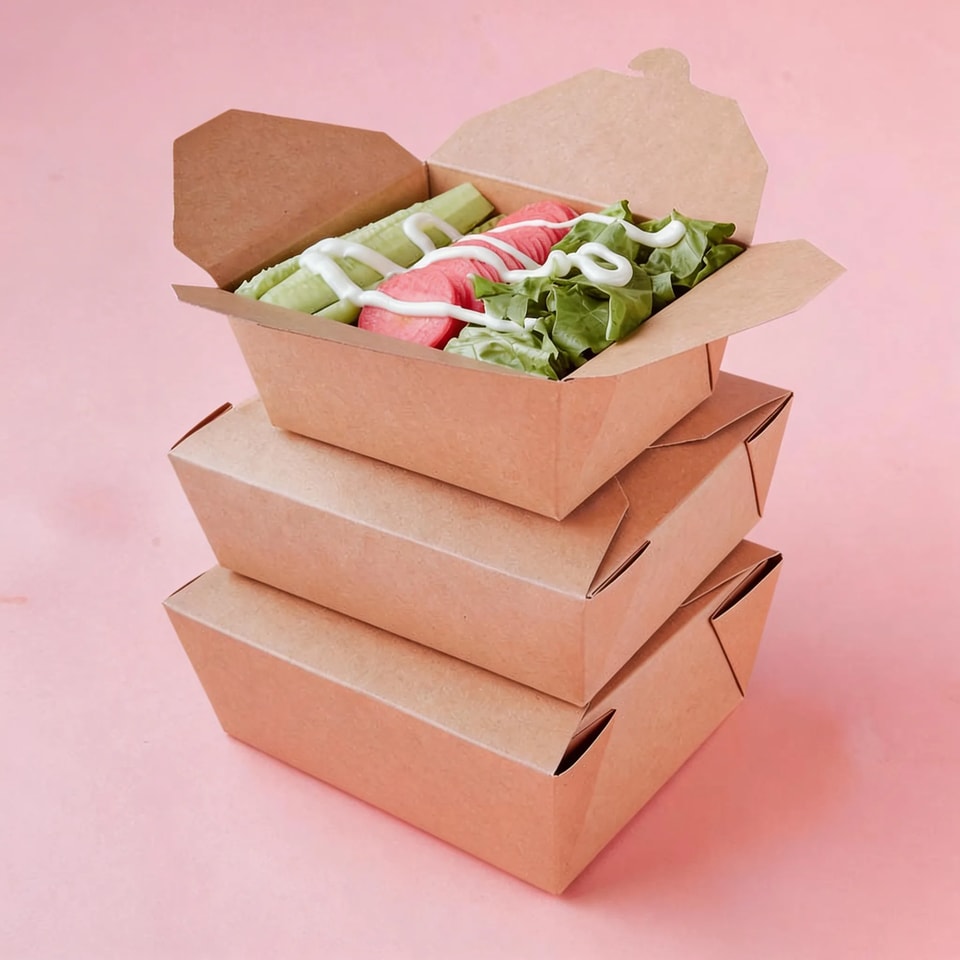
For restaurants, cafés, beverage chains, and delivery-first brands, a compostable takeaway box is part of the food experience from the kitchen to the customer’s table.
The right package needs to hold the intended portion, protect food quality during delivery, support efficient kitchen operations, present the brand consistently, and align with the documentation required in the destination market. As delivery orders become more frequent and menus become more diverse, takeaway packaging has become closely connected to restaurant operations, customer satisfaction, and long-term brand management.
Choosing a compostable takeaway box manufacturer should therefore involve more than comparing unit prices or asking whether a product is “eco-friendly.” A dependable decision connects the menu, container structure, food-contact requirements, sustainability claims, manufacturing controls, sample approval, and future supply planning.
For buyers building a broader paper-based packaging programme, compostable food containers can be assessed together with compatible bowls, cups, lids, and side-dish formats rather than as an isolated SKU.
What Should Restaurants Consider Before Choosing Compostable Takeaway Boxes?
A restaurant’s menu is the starting point for a meaningful packaging brief. The same container that works for a dry sandwich, pastry, fries, or rice dish may not be suitable for curry, soup noodles, saucy pasta, fried food, or a meal that stays in a delivery bag for 30 minutes.
Before comparing manufacturers, it is useful to group menu items by the conditions that influence packaging performance:
- Dry or low-moisture foods, such as bakery items, wraps, fries, and snacks
- Rice, grain, salad, and mixed-meal bowls
- Fried foods, oily dishes, and dishes with rich sauces
- Hot soups, noodles, curries, and other liquid-heavy meals
- Cold foods, desserts, fruit, and chilled side dishes
- Multi-item meals that require separated compartments
- Sauces, toppings, dressings, and side portions that may need smaller containers
This exercise helps procurement teams avoid selecting one generic takeaway box for every item on the menu. A package should fit how food is prepared, filled, closed, stacked, carried, delivered, and eaten—not merely how it looks in a product catalogue.
The delivery model also changes the requirement. A quick collection order may involve minimal movement, while a multi-item delivery order can expose containers to stacking pressure, steam, vibration, tilting, and longer holding times. As a result, packaging suitability must be judged under real operating conditions rather than by appearance alone.
How Do Menu Type and Delivery Conditions Affect Compostable Food Container Selection?
Once the food and delivery context are clear, restaurant requirements can be translated into a specification that manufacturers can use for quotation, sampling, and production. A broad enquiry for “biodegradable food packaging” often produces broad recommendations. A detailed brief helps suppliers recommend a suitable size, shape, paperboard, barrier construction, lid system, and production approach.
An RFQ for compostable takeaway boxes should normally define:
- Container type and intended food application
- Nominal capacity and practical serving volume
- External dimensions and required footprint
- Food temperature at filling
- Exposure to oil, moisture, sauce, steam, and liquids
- Expected holding time before dispatch
- Typical delivery duration and stacking conditions
- Lid, closure, or sealing requirements
- Single-, double-, or multi-compartment format
- Custom logo, artwork, colour, QR code, and regulatory text
- Estimated order quantity and reorder frequency
- Destination country or market
- Sampling, production, and delivery schedule
Capacity should be described carefully. Brimful volume and practical serving volume are not always the same. A container may technically hold 650 ml, but a sauce-heavy meal filled to that level may leave too little headspace for safe transport.
For example, a 650 ml dry rice meal may work well in a standard food container, while a 650 ml curry or braised dish may require more headspace, a more secure lid, or a different bowl-and-lid configuration. Practical serving volume is often more valuable than nominal capacity because it reflects how the food will actually be packed and delivered.
Anbao supports paper-based food packaging projects through product, capacity, material or coating, artwork, quantity, destination, and delivery requirement discussions. This information creates a more reliable basis for sampling, quotation, and production planning.
Which Paper Materials and Barrier Layers Suit Takeaway Food Packaging?
Paper-based takeaway packaging relies on a combination of materials and structural features. Paperboard gives the container its shape, stiffness, stackability, and printable surface. The food-contact layer, coating or barrier system, seams, folds, rim design, lid fit, and closure structure then influence how the package responds to moisture, grease, heat, steam, sauce, and liquids.
The most important question is not simply, “Is this box compostable?” It is whether the exact container construction can protect the intended food during the restaurant’s actual preparation, packing, and delivery process.
A paper food container may include several functional elements:
- Paperboard for rigidity, structural support, and print presentation
- A barrier layer for moisture, oil, sauce, and liquid resistance
- Food-contact inks, adhesives, and converting materials
- Folds, seams, rims, and closures that affect leakage performance
- A matching lid or cover that affects heat retention, spill control, and stackability
PE coating, PLA coating, and aqueous coating are among the barrier options used in paper food packaging. Each option can involve different considerations for food performance, sustainability positioning, regulatory requirements, and end-of-life handling. The appropriate selection depends on the food application, destination market, disposal route, and requirements for the final package.
For this reason, the final specification should identify the paperboard, barrier construction, food-contact materials, print configuration, and lid system. A broad statement that packaging is “eco-friendly” does not provide enough information to confirm whether it is suitable for a particular meal, market, or disposal environment.
Why Do Compostable Takeaway Boxes Need Real Delivery Testing?
A visual sample inspection can help confirm basic dimensions, appearance, and print quality, but it cannot fully show how a takeaway box will perform during normal restaurant service. The most useful evaluation reflects real use: actual food, normal filling temperature, typical holding time, standard delivery handling, and realistic stacking conditions.
Each shortlisted container should be tested with representative menu items. The trial should include the usual period between filling and dispatch, the number of packs normally carried together, and the level of movement expected during a delivery journey.
Key checks include:
- Does the base remain firm after exposure to steam, sauce, or moisture?
- Do seams, folds, corners, or closures soften or show signs of leakage?
- Does oil migrate through the material or affect the printed surface?
- Does the lid remain securely engaged after movement and stacking?
- Is there enough headspace to reduce splashing and overflow?
- Can staff fill and close the container efficiently during busy service periods?
- Can customers open the package without tearing, spilling, or damaging the food?
- Does the box maintain an acceptable appearance after delivery?
These checks are especially important for soups, curries, noodles, braised dishes, heavily dressed salads, and foods with high oil or liquid content. A package may look satisfactory when stationary but perform differently after stacking, transport, steam exposure, or repeated handling.
The container body and lid should always be tested as a matched system. A suitable container cannot compensate for an incompatible lid, while a secure lid cannot fully solve problems caused by insufficient headspace, weak seams, or an unsuitable food-container shape.
Choosing the Right Compostable Food Container Shape for Every Menu Format
Once the material system and delivery performance have been considered, container geometry becomes the next important packaging decision. Shape influences filling speed, food presentation, storage efficiency, stacking stability, delivery performance, and the way customers interact with the meal.
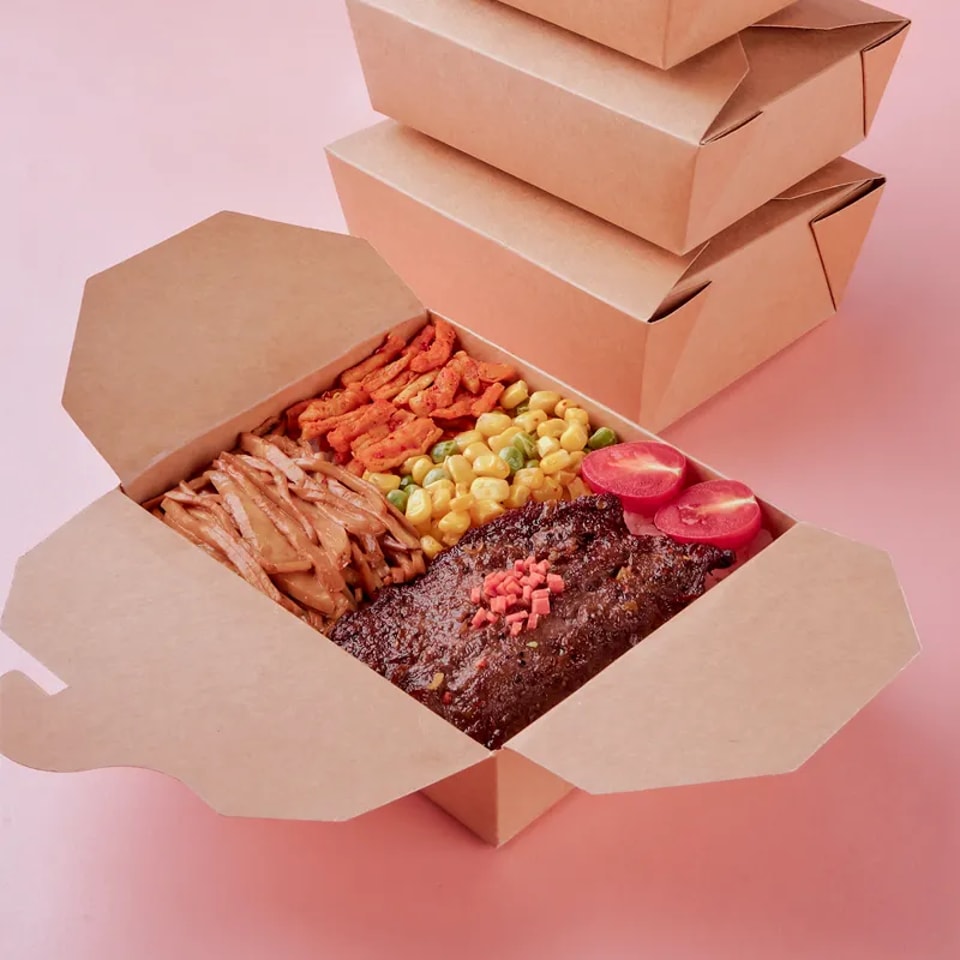
Round paper bowls are often suitable for soups, noodles, rice bowls, salads, fruit, and mixed meals. Rectangular or square food containers can work well for set meals, rice dishes, pasta, and foods that benefit from a more defined layout. Multi-compartment containers may help maintain separation between proteins, grains, vegetables, sauces, and side dishes.
The right geometry depends on the food and the restaurant’s service model rather than on a single universal rule.
- Round paper bowls can suit soups, curries, noodles, salads, rice bowls, and mixed meals.
- Rectangular or square food containers can support rice meals, pasta, prepared foods, and takeaway set meals.
- Compartment food containers can help separate food components in bento-style and prepared meal applications.
- Smaller matching containers can be used for sauces, dressings, toppings, and side dishes.
Anbao’s compostable food containers include multiple volume options and meal-container formats, helping restaurants combine main meals, side dishes, sauces, soups, and prepared foods within one coordinated packaging programme.
A practical qualification method is to test the packaging with the heaviest and most challenging menu item rather than the easiest one. If the container performs reliably with that item, it is more likely to provide a dependable solution for lighter dishes.
What Documents Support Compostable Food Packaging Claims?
Environmental claims in food packaging require more than general wording. Their relevance may vary according to the material structure, destination market, disposal infrastructure, collection system, and applicable regulations.
For restaurant buyers, sustainability should therefore be reviewed as both a material decision and a documentation decision.
Factory-level certifications, audits, and management systems can provide useful insight into how a manufacturer manages quality, environmental performance, raw materials, production processes, and social responsibility. However, a factory certification does not automatically prove that every product produced at the facility meets the food-contact, compostability, or market-specific requirements relevant to a particular order.
For each proposed takeaway box, buyers should request evidence that matches the final approved configuration, such as:
- Product-specific food-contact declarations
- Paperboard and barrier-layer specifications
- Information on inks and adhesives where relevant
- FSC or paper-source documentation where required
- Relevant third-party test reports or certificates
- Batch traceability and product-identification procedures
- Certificate scope, issuing body, and validity period
- Destination-market documentation requirements
The same discipline should apply to compostability claims. Buyers should clarify which material configuration is covered, whether the evidence applies to the proposed size, coating, print, and lid combination, and whether industrial composting infrastructure is required.
Environmental communication should match the actual product and the realistic disposal route in the market where it will be used. Specific, well-supported claims provide more lasting value than broad language that cannot be substantiated.
How Do Quality Control and Traceability Protect Custom Takeaway Packaging?
A successful sample is an important milestone, but it does not automatically guarantee consistent future production. For restaurant groups, distributors, and multi-location brands, the ability to reproduce the approved packaging version across repeat orders is just as important as the original design.
Small changes in paperboard, barrier layers, dimensions, lid fit, carton packing, or print colour can affect kitchen efficiency, delivery performance, product quality, and brand consistency. This makes traceability and change control essential elements of supplier qualification.
Manufacturers should be able to explain how they manage:
- Incoming material inspection
- Batch or lot identification
- In-process quality checks
- Finished-product inspection
- Artwork proofing and print-version control
- Approved sample retention
- Changes to paperboard, coatings, lids, dimensions, or packaging methods
- Complaint investigation and corrective action
- Customer notification before relevant material or process changes
For custom takeaway packaging, three approval records are especially valuable.
Approved artwork establishes the final logo, design, colour references, QR code, regulatory text, and print placement.
Approved sample provides a physical reference for container shape, size, material construction, print quality, lid fit, and in-use performance.
Approved specification records the paperboard, coating or barrier layer, capacity, dimensions, compatible lid, pack count, carton marking, and key quality requirements.
Together, these records help prevent artwork drift, colour inconsistency, incorrect dimensions, incompatible lids, or unapproved material substitutions during repeat production.
Can a Takeaway Box Manufacturer Support Your Complete Foodservice Packaging Programme?
Restaurants rarely need a single packaging format. A café may require hot cups, cold cups, food bowls, pastry packs, and takeaway containers. A delivery-first restaurant may need solutions for main meals, soups, side dishes, desserts, sauces, and beverages. As the product range expands, procurement coordination becomes more important.
A wider packaging portfolio can reduce unnecessary supplier fragmentation. It may also support more consistent artwork management, colour standards, lid compatibility, carton labelling, inventory planning, and replenishment across product categories.
Anbao supplies paper cups, paper bowls, food containers, ice cream cups, popcorn tubs, and compostable packaging solutions for coffee shops, restaurants, takeaway brands, beverage chains, event suppliers, foodservice distributors, and private-label buyers. Customisation is available for logos, patterns, colours, and sizes according to project requirements.
A coordinated packaging programme does not mean placing every SKU with one supplier regardless of product fit. Instead, it means assessing whether the supplier can support the formats that matter to the business and whether those products can be developed, tested, branded, and replenished in a consistent way.
This can simplify day-to-day operations. Kitchen teams work with approved container-and-lid combinations, purchasing teams manage a clearer set of specifications, and customers receive a more consistent experience across meals, drinks, snacks, and delivery orders.
What Does Reliable Long-Term Takeaway Box Supply Look Like?
As packaging moves from a single-store trial to recurring supply across multiple locations, manufacturing continuity becomes increasingly important. The supplier must be able to support production planning, quality management, custom printing, logistics coordination, and communication around future changes.
Questions that help assess long-term supply capability include:
- Does the manufacturer have experience with restaurant, beverage, takeaway, or foodservice-distribution applications?
- Can it support recurring orders and seasonal changes in demand?
- How does it manage production planning and finished-product inspection?
- What controls are used for custom-printing accuracy and repeat-order consistency?
- How are production delays, defects, supply disruptions, and specification changes handled?
- Can the supplier demonstrate relevant long-term food-packaging supply experience?
Anbao has focused on food packaging and customised solutions since 1996. Its international manufacturing development includes factory operations in Thailand and the United States, supporting foodservice packaging projects in different regional markets.
For large-scale paper packaging supply, Anbao served as a core packaging-material supplier for Master Kong instant noodles in Southwest China from 2004 to 2021. The programme involved a daily supply of 3 million paper bowls across Chengdu, Chongqing, and Kunming. During this period, the reported customer-use defect rate was 0.1 PPM, or approximately one non-subjective issue per 10 million units.
Anbao’s Chengdu and Nanjing subsidiaries also obtained manufacturing authorisation for Coca-Cola paper cups in China after reviews beginning in 2008. The sites subsequently completed Coca-Cola technical audits and third-party SGP assessments on an annual basis.
These examples do not replace product-specific testing or qualification for a new packaging project. They do, however, reflect the type of long-term production management, quality discipline, and supply continuity that restaurant buyers should consider when selecting a manufacturer.
How Do Samples and Pilot Orders Prepare a Compostable Takeaway Box for Launch?
The move from a packaging concept to regular production should be gradual and controlled. Samples and pilot orders allow buyers to validate not only the container itself, but also the manufacturer’s communication, custom-printing process, packing method, quality consistency, and delivery coordination.
A stock sample is useful for reviewing a basic shape or format, but it should not be treated as final approval for a customised order. The sample should match the intended production version as closely as possible in terms of:
- Dimensions and capacity
- Paperboard type and barrier construction
- Lid or closure format
- Food-contact materials
- Print process and artwork placement
- Pack count and outer-carton method
- Intended food application
- Destination-market documentation needs
If the final order changes from plain stock packaging to custom printing, or from one barrier construction to another, the relevant sample approval should be repeated. A similar-looking sample cannot reliably validate a different final specification.
The pilot should involve the people who use the packaging in daily operations:
- Kitchen staff who fill and close the container
- Front-of-house or dispatch staff who pack orders
- Delivery teams that handle stacked bags
- Operations teams that monitor consistency
- Customer-service teams that receive feedback
- Customers who open, eat from, and dispose of the packaging
Testing should take place during normal service, ideally including busy hours. Restaurant teams should use representative dishes, particularly the menu items most likely to create leakage, condensation, structural stress, or lid displacement.
When an issue is identified, the correction should be specific. The solution may involve a larger capacity, additional headspace, a revised lid, a different compartment layout, an alternative barrier system, or a separate package for sauces and liquids. Identifying these needs before a wider rollout is more efficient and less costly than addressing them after packaging has been distributed across multiple locations.
How Can Restaurants Choose the Right Compostable Takeaway Box Manufacturer?
Choosing a compostable takeaway box manufacturer is ultimately about selecting a packaging partner that understands the food, the kitchen workflow, the delivery route, the target market, and the realities of repeat supply.
The strongest purchasing decisions consider serving size, food temperature, sauce and moisture exposure, delivery duration, container geometry, paperboard, barrier performance, lid compatibility, food-contact documentation, sample testing, manufacturing controls, and future replenishment as connected parts of the same packaging programme.
Price remains an important part of the decision, but it is most useful when the technical configuration has already been aligned. A lower-priced box that leaks, softens, collapses, requires additional bags or sleeves, slows kitchen operations, or generates complaints is rarely the lowest-cost solution over time.
The same principle applies to sustainability positioning. A clearly documented claim, matched to the correct material construction and local disposal conditions, provides more value than broad environmental wording that cannot be substantiated.
For restaurant, beverage, and takeaway applications, Anbao Environmental Technology provides food packaging and customised solutions across paper cups, paper bowls, takeaway food containers, and compostable packaging. By sharing the menu application, target capacity, material or coating preference, artwork, destination market, and estimated order volume, buyers can develop a more focused product recommendation, sample plan, and quotation.
Explore Anbao’s compostable food containers to discuss a customised takeaway packaging project built around your restaurant’s food, operations, and long-term supply requirements.
Solutions & Support
We go the extra mile to analyze your specific project in detail and offer a tailored business solution that meets your requirements.
Contact US
×Support order samples, customization, wholesale direct, and complete payment. If the product you look for does not have corresponding customized content, pls fill out the form below to contact us, and we will reply ASAP.
Go to Contact Form →